英语
英语 西班牙语
西班牙语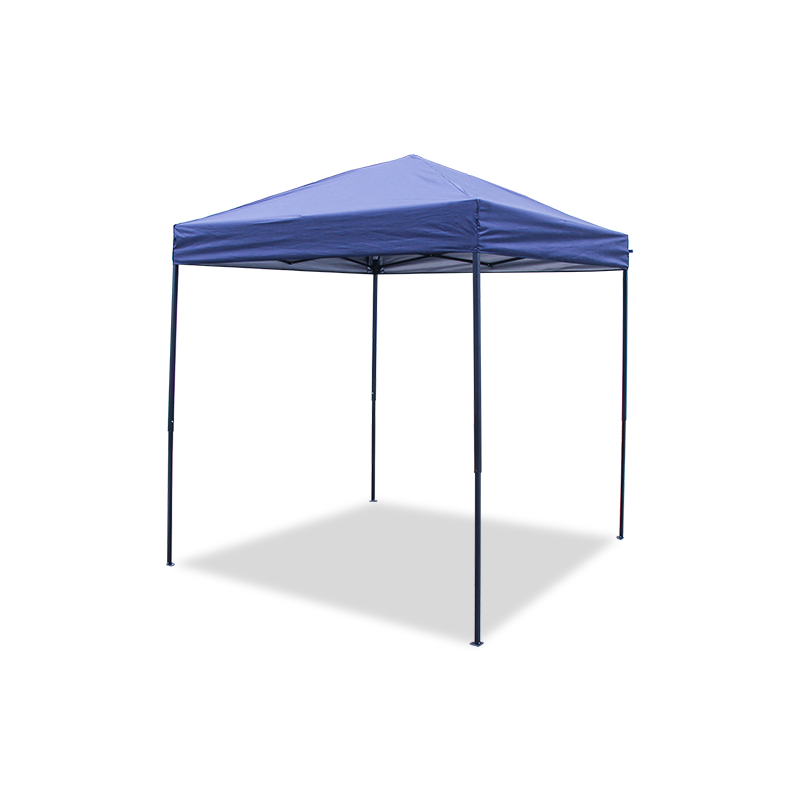
El cliente expresa intención; Comunicarse entre las dos partes; Proporcionar informes de análisis a los clientes; Llegar a una intención de cooperación.
Contenido
- 1 The Short Answer: What Can Replace a Canopy?
- 2 Why People Look for Canopy Alternatives in the First Place
- 3 Shade Sails: The Most Versatile Permanent Alternative
- 4 Pergolas: A Structural Canopy Replacement for Permanent Outdoor Spaces
- 5 Retractable Awnings: The Wall-Mounted Canopy Alternative
- 6 Gazebos: A Fully Enclosed Canopy Upgrade
- 7 Large Patio Umbrellas and Cantilever Umbrellas
- 8 Tarp Shelters: The Budget and Camping Alternative to Canopies
- 9 Carports: A Heavy-Duty Canopy Alternative for Vehicles and Large Coverage
- 10 Comparing Canopy Alternatives: A Quick Reference
- 11 Natural Shade: Trees, Hedges, and Living Structures
- 12 Outdoor Event and Market Alternatives to Pop-Up Canopies
- 13 How to Choose the Right Canopy Alternative for Your Situation
The Short Answer: What Can Replace a Canopy?
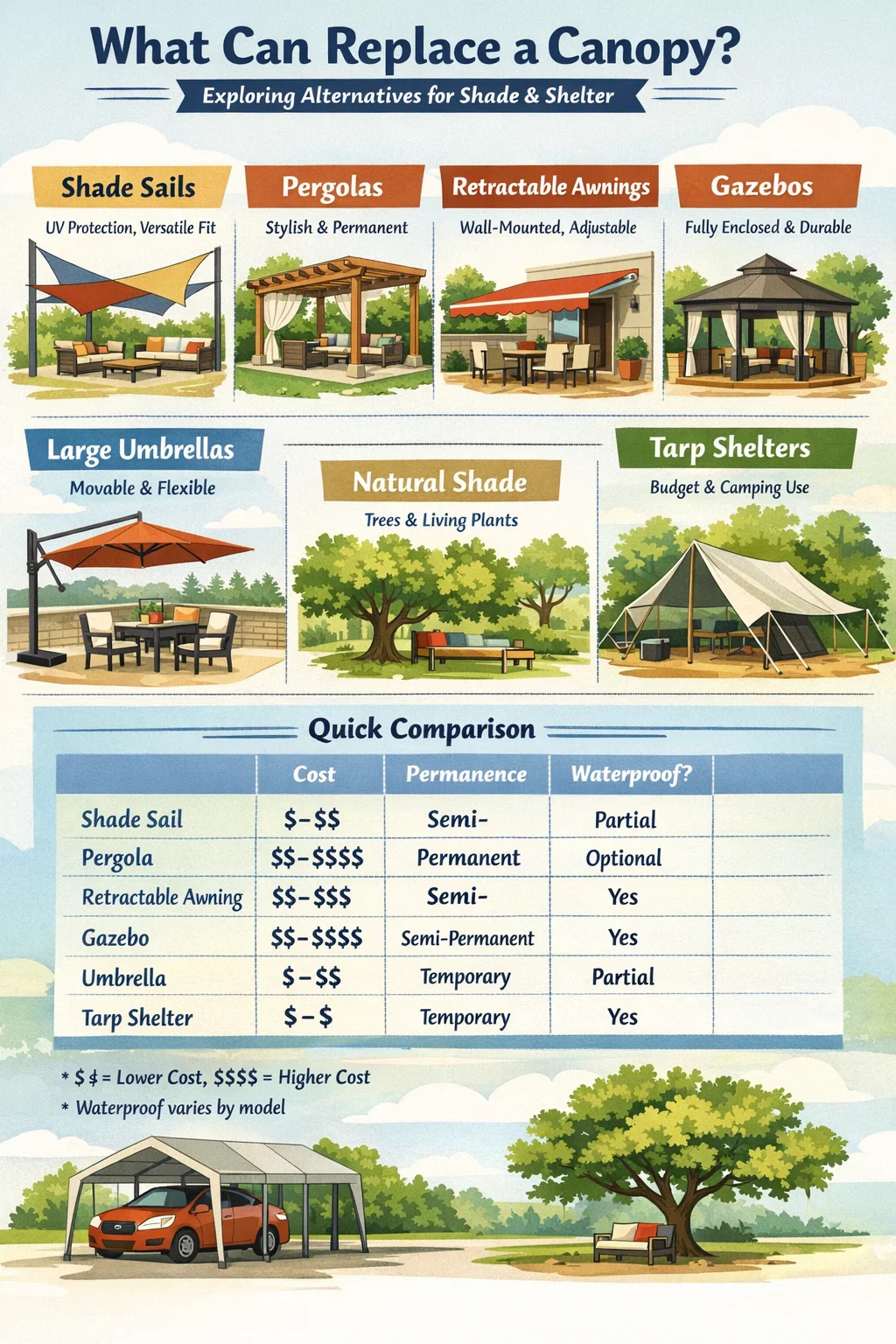
If you need shade, rain cover, or a defined outdoor space but don't want a traditional pop-up canopy, you have more options than most people realize. Shade sails, pergolas, retractable awnings, gazebos, umbrellas, and tarp shelters are all proven canopy alternatives — each with different strengths depending on your setting, budget, and how permanent you want the solution to be.
The right choice depends on where you're using it. A backyard installation calls for something different than a campsite setup or a vendor booth at a market. This guide walks through every viable alternative, what each one is genuinely good at, and where each one falls short — so you can make a decision based on your actual situation rather than marketing language.
Why People Look for Canopy Alternatives in the First Place
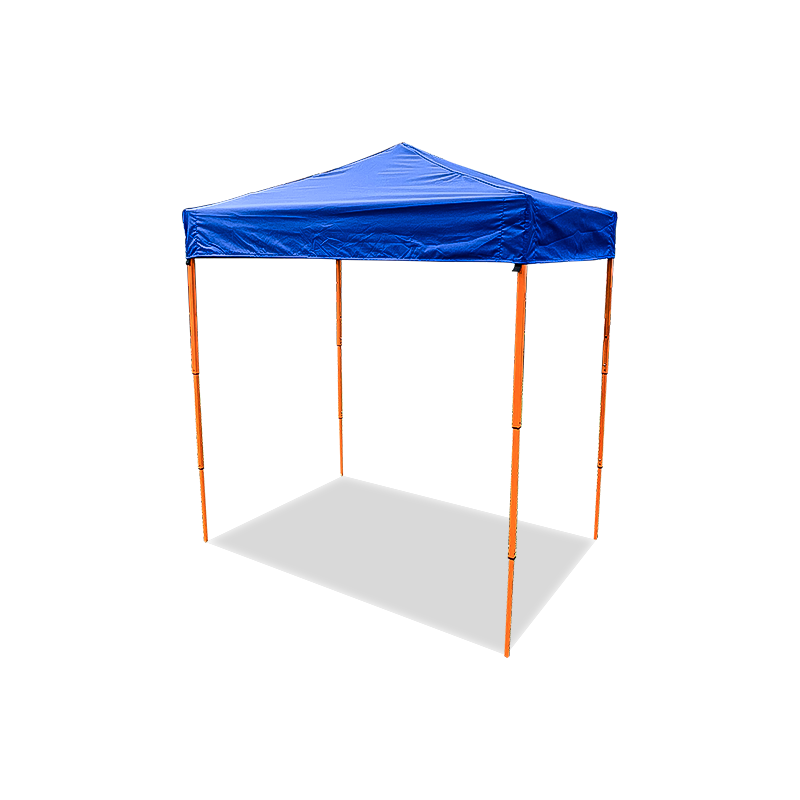
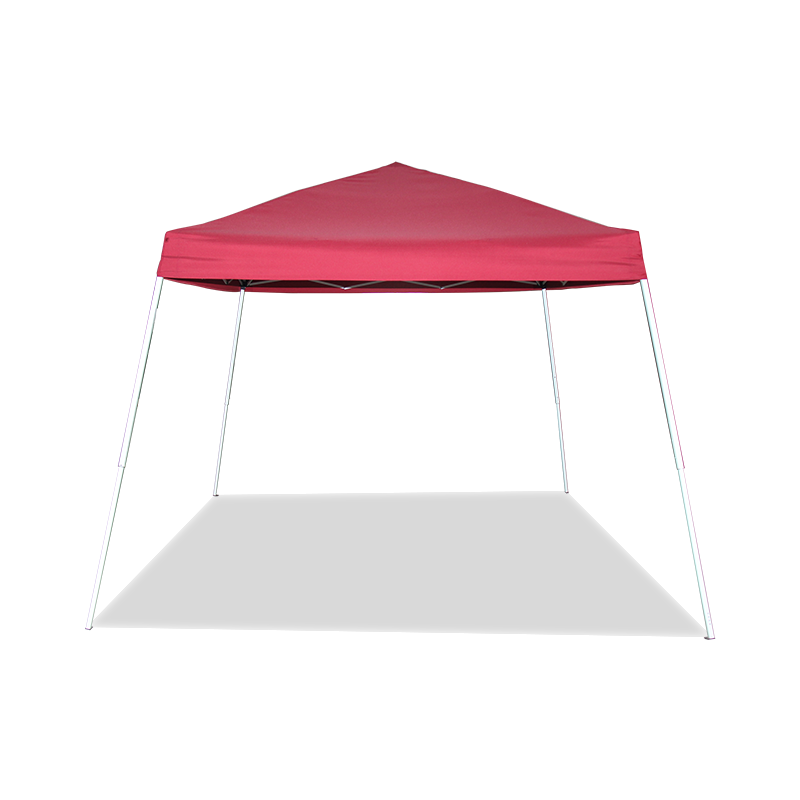
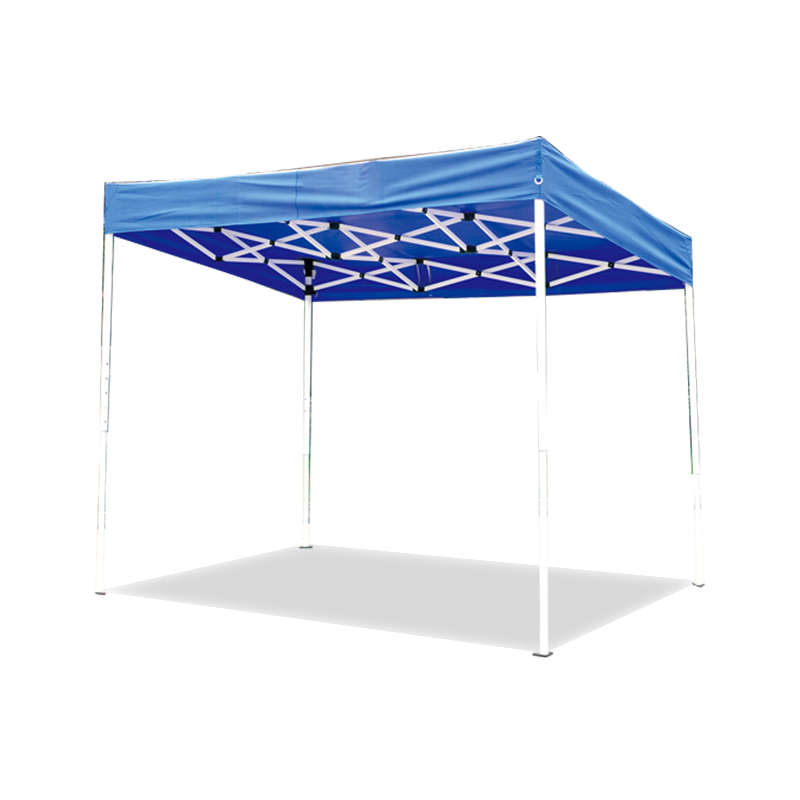
Standard pop-up canopies — the kind with metal or fiberglass frames and a polyester top — are convenient for events, but they come with real limitations. They're bulky to transport, susceptible to wind damage, and can look cheap in a residential setting. Many canopy frames warp or snap after a season or two of heavy use, especially budget models under $150.
People also seek alternatives because:
- They need a permanent or semi-permanent solution rather than something that folds away
- Local regulations or HOA rules restrict freestanding temporary structures
- They're covering an awkward shape or size that standard canopy frames don't suit
- They want a more attractive aesthetic for a patio, garden, or event setup
- They need something that holds up to consistent wind, UV exposure, or rain without constant repositioning
Each of the alternatives below addresses at least one of these problems more effectively than a conventional canopy would.
Shade Sails: The Most Versatile Permanent Alternative
Shade sails are triangular or quadrilateral pieces of tensioned fabric anchored to fixed points — posts, walls, trees, or a combination. They originated in Australia, where intense UV exposure made shade a practical necessity rather than a luxury, and they've since become a popular canopy alternative worldwide.
What Makes Shade Sails Worth Considering
A quality shade sail made from high-density polyethylene (HDPE) fabric — the standard material for most commercial-grade versions — can block 90 to 97% of UV radiation while still allowing airflow. This is a meaningful advantage over solid canopy covers, which trap heat underneath and can make a shaded area feel stuffy on warm days.
Shade sails are also highly adaptable to irregular outdoor spaces. Because they mount to existing structures, you can cover areas that a standard canopy frame simply wouldn't fit — narrow side passages, L-shaped patios, or unusually large garden sections. Multiple overlapping sails can create a layered look that's far more architecturally interesting than a flat canopy roof.
Cost and Installation Reality
Residential shade sails range from about $30 for basic imported versions to over $400 for premium commercial-grade options. Installation posts — if you don't have existing anchor points — add another $150 to $600 depending on material and whether you hire a contractor. The tensioning hardware matters significantly; cheap plastic hardware fails within a season in exposed conditions.
One honest limitation: shade sails are not waterproof by default. Standard HDPE fabric is water-resistant and will handle light rain, but heavy or sustained rain will find its way through. Waterproof PVC shade sails exist and solve this problem, but they sacrifice the breathability that makes the material appealing in the first place.
Pergolas: A Structural Canopy Replacement for Permanent Outdoor Spaces
A pergola is an open-roofed outdoor structure with vertical posts and horizontal crossbeams or lattice. By itself, a pergola doesn't provide full shade — the open slat design filters rather than blocks sunlight. But when combined with additional covering material, a pergola becomes one of the most robust canopy alternatives available.
How People Use Pergolas as Canopy Replacements
The structural frame of a pergola supports a wide range of covering options:
- Retractable canopy panels that slide along the crossbeams, allowing you to open or close the shade based on weather
- Shade cloth or mesh fabric draped across the top, stapled or tied to the frame
- Climbing plants like wisteria, grapevines, or jasmine trained up the posts and across the top — a living canopy that grows denser over time
- Polycarbonate or glass panels for a transparent weatherproof roof that maintains light while blocking rain
A basic freestanding wood pergola kit costs between $500 and $2,500 for the structure alone. Aluminum and vinyl versions run slightly higher but require almost no maintenance. Professional installation adds labor costs, but many pergola kits are designed for DIY assembly over a weekend.
Louvered Pergolas: The Premium Option
Louvered pergolas have adjustable aluminum slats that rotate to control shade and rain protection. High-end louvered systems from brands like Renson or Brustor cost between $5,000 and $25,000 installed, but they function essentially as a permanent, weatherproof outdoor room. Many include integrated LED lighting, heating elements, and rain sensors that automatically close the louvers when rain is detected.
Retractable Awnings: The Wall-Mounted Canopy Alternative
A retractable awning mounts directly to an exterior wall and extends outward to create a shaded area over a patio, deck, or doorway. Unlike a canopy, it requires no ground-level supports or anchor points and can be retracted completely when not needed — which matters in high-wind conditions or during the off-season.
Retractable awnings are one of the most practical canopy replacements for residential settings where a permanent freestanding structure isn't possible or desirable. They work well for:
- Covering sliding or French door openings where a canopy frame would block access
- Apartments or rentals where permanent ground installations aren't permitted
- Narrow decks where outrigger posts would take up too much usable space
- Situations where you want full sun access in winter and shade in summer
Manual vs. Motorized Awnings
Manual crank awnings cost between $200 and $800 for the unit itself, with installation adding another $100 to $300. Motorized versions — operated by remote control, smartphone app, or wall switch — start around $700 and can reach $3,000 or more for wide commercial-grade units. Wind sensors that automatically retract the awning during gusts are a worthwhile addition; awning fabric and frames are vulnerable to wind damage when extended.
Projection (how far the awning extends from the wall) typically ranges from 8 to 14 feet on residential units. This covers most standard patios adequately, though unusually deep outdoor areas may need multiple units side by side.
Gazebos: A Fully Enclosed Canopy Upgrade
A gazebo is a freestanding outdoor structure with a solid roof, open or partially enclosed sides, and its own frame. It functions as a canopy alternative but with significantly more coverage and structural integrity. Many gazebos include mosquito netting panels, curtain tracks, or solid side walls for weather protection.
The key difference between a gazebo and a pop-up canopy is permanence and durability. A well-built hardtop gazebo with an aluminum or steel frame and polycarbonate or metal roof panels can withstand years of outdoor exposure with minimal maintenance — something a fabric canopy fundamentally cannot do.
Soft-Top vs. Hard-Top Gazebos
Soft-top gazebos use fabric or mesh roofing similar to canopy material and are typically more affordable ($150 to $600) but share the canopy's weakness against wind and UV degradation. Hard-top gazebos with metal or polycarbonate roofing cost considerably more — usually $600 to $3,000 for a quality freestanding unit — but provide genuinely weatherproof coverage.
For anyone who uses their outdoor space regularly across multiple seasons, a hardtop gazebo is almost always the better long-term investment compared to repeatedly replacing canopy covers or frames. The per-year cost difference often narrows significantly when factored over five or ten years of use.
Large Patio Umbrellas and Cantilever Umbrellas
For smaller coverage areas or situations where you want flexibility rather than a fixed structure, oversized patio umbrellas are a practical canopy alternative. Standard market umbrellas top out at around 11 feet in diameter, which covers a dining table for six comfortably. Cantilever or offset umbrellas extend that coverage further and place the pole to the side rather than through the center of a table, making them more functional for lounge setups.
When an Umbrella Beats a Canopy
Umbrellas excel in situations where:
- You need to move the shade around throughout the day as the sun changes position
- The covered area is small enough that a canopy frame would feel oversized or awkward
- Storage space is extremely limited and a folded umbrella is easier to manage than a canopy bag and frame
- Budget is a significant factor — a quality cantilever umbrella with a weighted base can be had for $200 to $500
Commercial-grade cantilever umbrellas used for restaurant patios or hotel pool areas can reach 13 to 16 feet in diameter and cost $1,000 to $4,000, but these are essentially canopy-level coverage with the footprint of a single post.
Weight and Wind Stability
The main weakness of any freestanding umbrella is wind. A cantilever umbrella with a 13-foot canopy has significant sail area and will tip or blow away without a very heavy base — typically at least 100 to 150 pounds of ballast for larger sizes. This is rarely emphasized in product listings, but it's the difference between a stable installation and a dangerous one.
Tarp Shelters: The Budget and Camping Alternative to Canopies
For outdoor events, camping, or temporary coverage without any infrastructure, a rigged tarp is often the most practical canopy alternative. Tarps are inexpensive, available in large sizes, and incredibly flexible in how they can be configured.
A standard 10×20 foot polyethylene tarp costs $20 to $60 and covers the same ground area as a mid-size canopy. Silnylon or Dyneema tarps used by backpackers are lighter and pack smaller, though they cost significantly more. When rigged with trekking poles, rope, and stakes, a tarp shelter can be set up and taken down faster than most canopy frames and weighs a fraction as much.
Tarp Configuration Options
Unlike a canopy, a tarp can be pitched at multiple angles depending on conditions:
- A-frame or ridge line pitch — high in the center, sloped on both sides, shedding rain effectively and providing partial side protection
- Lean-to pitch — one high edge and one low edge staked to the ground, giving full windbreak protection on one side
- Flat horizontal pitch — mimics a canopy layout, suitable for mild weather with no significant rain or wind
- Porch pitch — attached to the side of a tent or structure and angled down, extending the covered area
The limitation of tarp shelters is that they look utilitarian and require some knot-tying or rigging skill to set up properly. For backyard use or upscale events, this is usually a dealbreaker — but for camping, festivals, or functional worksites, it's hard to beat the value.
Carports: A Heavy-Duty Canopy Alternative for Vehicles and Large Coverage
If the reason you need a canopy is to cover a vehicle, equipment, or a large work area, a portable carport is worth considering seriously. These are essentially heavy-duty canopy frames with more robust steel tubing, wider coverage, and fabric or metal panel roofing designed for year-round outdoor exposure.
A basic portable canopy-style carport (10×20 feet) runs $150 to $400, while more substantial steel carports with anchored frames and metal roofing cost $800 to $3,000 or more. These can double as tool storage, equipment shelters, or large covered entertaining areas when not being used for vehicles.
One consideration: many municipalities require a permit for carport structures, particularly permanent ones or those attached to a building. It's worth checking local regulations before purchasing.
Comparing Canopy Alternatives: A Quick Reference
| Alternative | Best For | Typical Cost Range | Permanence | Waterproof? |
|---|---|---|---|---|
| Shade Sail | Irregular spaces, UV protection | $30–$400+ | Semi-permanent | Partial (PVC versions: yes) |
| Pergola | Permanent patios, aesthetic value | $500–$25,000 | Permanent | Depends on cover added |
| Retractable Awning | Wall-adjacent patios, flexibility | $200–$3,000 | Semi-permanent | Yes (most models) |
| Hard-Top Gazebo | Year-round outdoor rooms | $600–$3,000+ | Semi to permanent | Yes |
| Cantilever Umbrella | Small patios, flexibility | $200–$4,000 | Temporary / movable | Partial |
| Tarp Shelter | Camping, budget setups | $20–$100 | Temporary | Yes |
| Portable Carport | Vehicles, large equipment | $150–$3,000 | Semi-permanent | Yes (metal roofing) |
Natural Shade: Trees, Hedges, and Living Structures
It's easy to overlook the most low-maintenance canopy alternative of all: plants. A well-placed deciduous tree provides deep, dappled shade in summer while allowing full sun through its bare branches in winter — something no built structure can replicate. Fast-growing species like silver maple, tulip poplar, or empress tree can provide meaningful canopy cover within three to five years of planting.
For more immediate results, large container plants or hedges can define a shaded area without any permanent construction. Bamboo hedges in tall planters, for instance, create a living privacy screen and partial shade barrier that's both visually interesting and completely removable.
Living canopy structures — pergola frames deliberately planted with fast-climbing vines — are increasingly popular in European gardens and are beginning to appear in North American residential landscaping. Wisteria, Virginia creeper, and climbing hydrangea all produce dense overhead cover within a few growing seasons and require only the initial investment in the supporting structure.
The honest downside of living shade is timing and control. You can't deploy a tree when you need shade this Saturday. Plants take seasons to establish, and their coverage changes through the year. For permanent residential installations where timeline is flexible, though, living shade is hard to beat on total value and visual appeal.
Outdoor Event and Market Alternatives to Pop-Up Canopies
For vendors, market sellers, or event organizers who typically use pop-up canopy tents, a few alternatives offer better functionality without the hassle of assembling and transporting a canopy frame.
Inflatable Tents
Inflatable frame tents replace the metal poles of a standard canopy with air-pressurized tubes. They set up in under five minutes with a pump, weigh significantly less than equivalent metal-frame canopies, and are more resistant to wind because the flexible frame absorbs impact rather than resisting it rigidly. Entry-level inflatable event tents start around $400 to $800; commercial versions with printed panels for brand visibility reach $1,500 and up.
Stretch Tents
Stretch tents (also called Bedouin tents or freeform tents) are made from elasticized fabric that can be configured in a wide range of shapes and heights. They're anchored to poles at multiple points and can be pitched asymmetrically to suit irregular spaces. Used widely at outdoor festivals and upscale events in Europe and South Africa, they're gaining popularity in North America as a premium canopy alternative for weddings, pop-up restaurants, and large parties.
Stretch tents don't pack down as small as a standard canopy, but they're far more visually striking and can cover much larger areas in a single piece — typically 5×5 meters up to 15×20 meters for large commercial versions.
Party Tents and Frame Tents
For larger events, a proper frame tent or pole tent replaces a cluster of smaller canopies with a single covered space. Frame tents use a self-supporting steel structure and range from 10×10 feet up to 40×100 feet or more for commercial rental inventory. They're not portable in the same sense as a pop-up canopy, but for a fixed venue or recurring event in one location, they're considerably more weatherproof and professional in appearance.
How to Choose the Right Canopy Alternative for Your Situation
The best starting point is being specific about what you actually need the cover to do. Shade and rain protection are two different problems, and many people try to solve both with a single solution that does neither especially well.
Work through these questions before deciding:
- How permanent does the solution need to be? If you move frequently or rent your property, anything requiring concrete anchors or permanent wall mounting creates problems. Shade sails, umbrellas, and tarp shelters keep your options open. If you own and plan to stay, investing in a pergola or retractable awning makes more financial sense over time.
- What size area do you need to cover? For anything under about 100 square feet, a large umbrella or small shade sail is usually sufficient. For 100 to 400 square feet, a gazebo, retractable awning, or shade sail system makes more sense. Above 400 square feet, you're looking at pergola structures or multiple interconnected solutions.
- Does rain protection matter, or is shade the main concern? If you're in a high-rainfall area or need to stay dry during events, waterproof solutions like hard-top gazebos, retractable awnings, and PVC shade sails are necessary. Standard HDPE shade sails and open pergolas without additional covering won't keep you dry in sustained rain.
- What's your wind exposure like? Coastal properties, rooftop terraces, and open fields require wind-rated solutions. Shade sails must be properly tensioned and anchored to posts with adequate footings. Freestanding umbrellas need very heavy bases. Pergolas and gazebos with proper anchoring are generally more wind-stable than anything fabric-based and freestanding.
- What's your realistic budget, including installation? The listed purchase price of a shade structure rarely tells the whole story. Factor in installation hardware, concrete for post footings, any required permits, and professional installation if you're not doing it yourself. A $200 shade sail system can easily become a $600 to $1,000 installed solution once all costs are included.
None of these alternatives is universally better than a canopy — each one trades something to gain something else. What most of them share is that they're more durable, more attractive, or more functional than a standard pop-up canopy in specific conditions. Knowing which of those things matters most to you is what makes the decision straightforward.